




McCarthy Jeep RAM Chrysler Dodge of Lee’s Summit

Blog

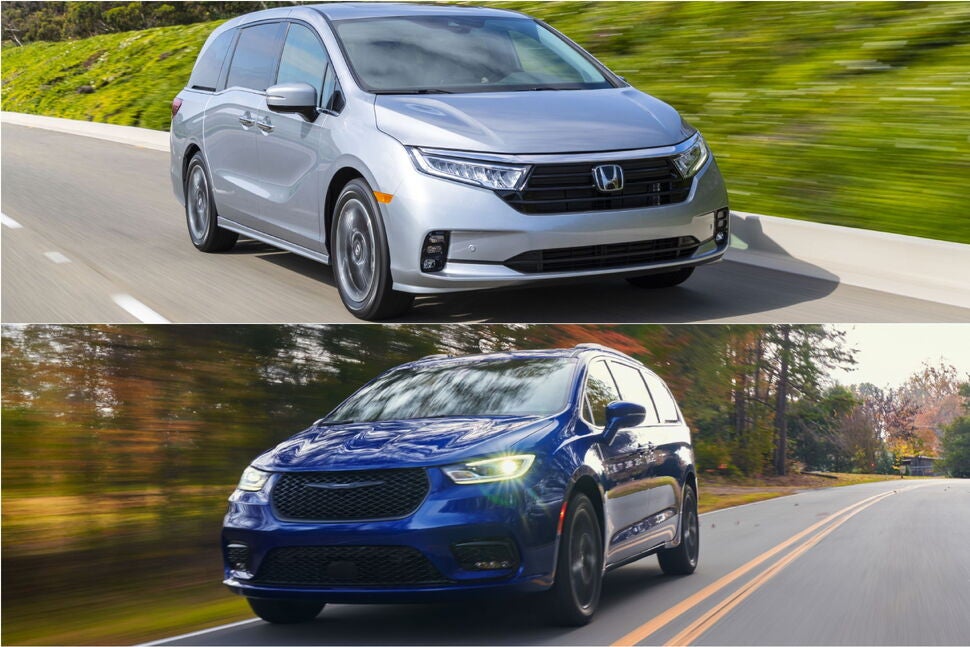
Chrysler Pacifica vs. Honda Odyssey

2026 Chrysler Pacifica with Stow 'n Go seats folded at McCarthy Jeep Ram Chrysler Dodge in Lee's Summit, MO

If you're shopping for a minivan, chances are the Chrysler Pacifica and the Honda Odyssey are at the top of your list. Both are roomy, comfortable, family-friendly vans with V6 power and plenty of features. But when you look closer, they take different approaches to the things families care about most: how the seats fold, how much cargo you can carry, how much you can tow and how the van handles a snowy Kansas City morning.

The short answer

The 2026 Chrysler Pacifica stands out with available all-wheel drive, Stow 'n Go seats that fold into the floor without lifting them out, slightly more horsepower and up to 3,600 pounds of towing capacity. The 2026 Honda Odyssey is front-wheel drive only and offers eight-passenger seating on every trim and slightly more cargo space when you remove its second-row seats. For Kansas City families who want winter traction and the easiest way to switch between passengers and cargo, the Pacifica has a real edge.

In this guide, we'll compare the 2026 Pacifica and Odyssey head to head on power, all-weather capability, seating, cargo, towing, fuel economy and family features, using the automakers' published specs. We'll also show how each fits real life in Lee's Summit and the Kansas City area, from school drop-offs and sports tournaments to road trips and winter weather.

Pacifica vs. Odyssey at a Glance

Here's how the 2026 models compare, based on Honda's published 2026 Odyssey specifications and published 2026 Pacifica specifications.

2026 Chrysler Pacifica 2026 Honda Odyssey
Engine 3.6L Pentastar V6 3.5L V6
Horsepower / torque 287 hp / 262 lb-ft 280 hp / 262 lb-ft
Transmission 9-speed automatic 10-speed automatic
Drivetrain Front-wheel drive or available all-wheel drive Front-wheel drive only
Seating 7 or 8 passengers 8 passengers
Second-row seats Available Stow 'n Go: fold into the floor Magic Slide: slide side to side; removable
Cargo behind 3rd row 32.3 cu ft 32.8 cu ft
Max cargo 140.5 cu ft Up to 155.8 cu ft (with second-row seats removed)
Max towing Up to 3,600 lb with available Trailer Tow Group Up to 3,500 lb
EPA fuel economy Up to 19 city / 28 highway / 22 combined 19 city / 28 highway / 22 combined
Length 204.3 in 205.2 in

On paper, these two vans are remarkably close in size, power and fuel economy. The real differences come down to all-wheel drive, how the seats work and a few key family features.

All-Wheel Drive: The Pacifica's Biggest Advantage

This is the single biggest difference between the two, and it matters a lot in the Kansas City area.

The Chrysler Pacifica offers available all-wheel drive. The system works automatically and engages based on conditions such as pulling away from a stop, cold outside temperatures, windshield wiper use and wheel slip. When it isn't needed, it disconnects to help save fuel. And unlike some AWD minivans, the AWD Pacifica keeps its Stow 'n Go second-row seats.

According to Honda's 2026 specifications, the Odyssey is front-wheel drive only.

Front-wheel drive with good tires handles most winter driving well. But if you live on a hilly street in Lee's Summit, a long driveway in Lone Jack or a cul-de-sac in Blue Springs that's always the last to get plowed, AWD makes pulling away and climbing hills on snow and slush noticeably easier. Remember that AWD helps you go, not stop, so pair it with good tires and careful driving. Read more in our guides to 4WD vs. AWD in snow and ice and all-season vs. winter vs. all-terrain tires.

Seating: Stow 'n Go vs. Magic Slide

How the seats work may be the feature you use most, every single week.

Chrysler Pacifica: Stow 'n Go

Chrysler calls Stow 'n Go a class-exclusive feature. On equipped models, both the second-row seats and the 60/40 split third-row bench fold flat into the floor. You don't need to lift heavy seats out of the van or find somewhere to store them. In a few minutes, you can go from carrying the whole soccer team to hauling a new bookshelf home from the store.

When the second-row seats are up, the in-floor bins can also be used as hidden storage for snacks, sports gear or anything you'd rather keep out of sight. Chrysler says the Pacifica offers up to 243 seating configurations.

Honda Odyssey: Magic Slide

The Odyssey's second-row Magic Slide seats can slide side to side, which makes it easy to get to the third row or move a car seat closer to a sibling. It's a clever, family-friendly design. To reach the Odyssey's maximum cargo space, though, the second-row seats need to be removed from the van and stored somewhere else.

The verdict on seating

If you regularly switch between hauling people and hauling stuff, the Pacifica's Stow 'n Go is hard to beat. If you rarely remove the second row and want flexible sliding seats, the Odyssey's Magic Slide is a strong feature. The Odyssey also seats eight on every trim. The Pacifica seats seven, with eight-passenger seating available on front-wheel-drive Select models, according to MoparInsiders. If you need both AWD and eight seats, that's an important detail to know.

Cargo Space

Behind the third row, the two vans are nearly identical: 32.3 cubic feet in the Pacifica and 32.8 cubic feet in the Odyssey. That's plenty of room for groceries, a stroller or a week's worth of luggage.

For maximum cargo, the Pacifica offers 140.5 cubic feet with its seats folded into the floor. Honda lists up to 155.8 cubic feet for the Odyssey with the second-row seats removed. So the Odyssey can technically hold a bit more, but only after you lift out and store the second-row seats. The Pacifica gets you close to that number without leaving the seats in your garage.

Towing

Many families tow a small camper, a utility trailer or jet skis to the lake. With its available Trailer Tow Group, the Pacifica can tow up to 3,600 pounds, which Chrysler calls best in class. Honda rates the Odyssey at up to 3,500 pounds. The difference is small, but both vans can handle many small trailers. Always check the loaded weight of your trailer and the rating for your specific van.

Need to tow more? A Dodge Durango or a Ram 1500 can tow much heavier loads. Our guide to Ram 1500 towing capacity explains how to match a vehicle to your trailer.

Performance and Fuel Economy

The Pacifica's 3.6-liter Pentastar V6 makes 287 horsepower and 262 lb-ft of torque and pairs with a nine-speed automatic. The Odyssey's 3.5-liter V6 makes 280 horsepower and 262 lb-ft of torque with a 10-speed automatic. Both deliver smooth, confident acceleration for merging onto I-470 or passing on the highway with a full load.

Fuel economy is essentially a tie. Both vans are rated at up to 19 mpg city, 28 mpg highway and 22 mpg combined. Check the window sticker for the specific configuration you're considering, since AWD and other options can affect the numbers.

One note: the Pacifica Plug-in Hybrid was discontinued for the 2026 model year, along with Stellantis' other U.S. plug-in hybrids. If you're interested in a Pacifica Hybrid, ask our team about certified pre-owned models.

Family-Friendly Features

Both vans are packed with features designed for busy families. A few highlights to compare when you test drive:

  • Safety: Chrysler says the Pacifica offers the most standard safety and security features in its class. Compare the specific driver-assistance features on the trims you're considering, such as automatic emergency braking, blind-spot monitoring and adaptive cruise control.
  • Camera systems: the Pacifica's available surround-view camera makes parking in tight school pickup lines and crowded lots easier.
  • Hands-free doors: the Pacifica offers available hands-free sliding doors and liftgate, which help when your arms are full.
  • Interior storage: the Pacifica's Stow 'n Go bins add hidden storage when the seats are up.
  • Rear-seat entertainment: the Pacifica's available Uconnect Theater Family Group keeps kids entertained on long drives.
  • Sunroof: the Pacifica offers an available dual-pane sunroof.

Features vary by trim, so the best approach is to compare the specific trims that fit your budget side by side.

2026 Chrysler Pacifica Trims at a Glance

According to MoparInsiders' 2026 buyer's guide, the gas-powered Pacifica comes in three main trims, plus a special edition. Front-wheel drive is standard on all three, and all-wheel drive is available.

  • Pacifica Select: the starting point, with second-row bucket seats with in-floor bins and available eight-passenger seating on front-wheel-drive models. The available Uconnect Theater Family Group adds rear-seat entertainment.
  • Pacifica 100th Anniversary Edition: new for 2026 and built on the Select, celebrating Chrysler's centennial with unique badging, Luster Gray polished wheels, Granite Crystal accents and added safety technology.
  • Pacifica Limited: adds second-row Stow 'n Go bucket seats with in-floor bins, a standard hands-free power liftgate and available hands-free power sliding doors.
  • Pacifica Pinnacle: the most luxurious Pacifica, with a power-folding third-row Stow 'n Go bench, standard hands-free sliding doors and liftgate and the Safety Sphere Group, including a 360-degree camera and front park assist.

Standard safety on every Pacifica

MoparInsiders lists these driver-assistance features as standard on all 2026 Pacifica trims:

  • Blind-spot monitoring with rear cross-path detection
  • Lane departure warning
  • Adaptive cruise control with stop and go
  • ParkSense rear park assist with stop
  • Pedestrian automatic emergency braking

That's a strong standard safety list for a family vehicle, and it's one reason Chrysler says the Pacifica offers the most standard safety and security features in its class.

Which Minivan Is Right for Your Family?

Choose the Chrysler Pacifica if you:

  • Want available all-wheel drive for Kansas City winters
  • Switch between passengers and cargo often and don't want to lift seats out
  • Want a little more towing capacity for a small camper or boat
  • Like the idea of hidden in-floor storage
  • Want a slightly more powerful V6

Choose the Honda Odyssey if you:

  • Need eight seats on every trim
  • Like the flexibility of sliding second-row seats
  • Don't need all-wheel drive
  • Want the absolute maximum cargo space and don't mind removing seats to get it

Both are excellent family vans. The best way to decide is to bring the whole family, car seats and all, and try them out.

Car Seats, Kids and Everyday Logistics

For many families, a minivan is really a car-seat carrier with an engine. Before you buy, it's worth thinking through how your family will actually use the van every day:

  • Bring your car seats to the test drive. Install them where they'll actually go, and see how easy it is for older kids to climb past them to the third row.
  • Count your carpool. If you regularly drive more than seven people, make sure you choose an eight-passenger configuration.
  • Think about third-row access. Try getting in and out of the third row yourself, not just the kids.
  • Test the cargo area with a full third row. Bring a stroller, sports bags or a cooler to see what fits behind the third row with every seat in use.
  • Picture your messiest day. Muddy soccer cleats, wet swim bags and spilled snacks happen. Ask about all-weather floor mats and seat protection.

Life With a Minivan in the Kansas City Area

  • School and activities: Sliding doors are a lifesaver in tight school pickup lines and crowded parking lots in Lee's Summit, Blue Springs and Overland Park.
  • Sports tournaments: Weekend trips to tournaments across the metro mean hauling kids, coolers, chairs and gear. Flexible seating makes the switch easy.
  • Road trips: Whether you're heading to Lake of the Ozarks, Branson, Omaha or St. Louis, a minivan's comfort and cargo space make long drives easier on everyone.
  • Winter mornings: January averages lows around 24°F in Kansas City, and snow can fall from November through April. Available AWD and good tires help the Pacifica get the kids where they need to go.
  • Home projects: With Stow 'n Go seats folded, a Pacifica can carry furniture, flat-pack boxes and building supplies without a pickup truck.

Minivan Myths, Busted

"Minivans can't handle winter."

With available all-wheel drive and good tires, a Pacifica handles typical Kansas City winter weather with confidence. Even front-wheel-drive minivans do well on plowed roads with the right tires, since the engine's weight sits over the front drive wheels.

"SUVs have more room."

Most three-row SUVs can't match a minivan's interior space. Low floors, tall roofs and boxy shapes give minivans more usable room for passengers and cargo, and sliding doors make that space far easier to reach.

"Minivans can't tow anything."

The Pacifica can tow up to 3,600 pounds with the available Trailer Tow Group, enough for many small campers, utility trailers and personal watercraft.

"Minivans are boring."

Today's minivans offer smooth V6 power, advanced safety technology, big touchscreens and premium interiors. And once you've experienced sliding doors in a tight parking lot on a rainy day, you may never want to go back.

Keeping Your Minivan Family-Ready

Minivans work hard, so a little maintenance goes a long way. Follow your oil change indicator, rotate your tires regularly, keep an eye on the battery before winter and check the sliding door tracks for debris. Our guides to oil change intervals and the 7 signs your car battery is dying are good places to start.

Thinking About a Three-Row SUV Instead?

Some families cross-shop minivans with three-row SUVs. If you want more towing capacity or a sportier image, take a look at the Dodge Durango, which offers available all-wheel drive, three rows of seating and a V6 or HEMI V8, or a Jeep Wagoneer. Minivans still win on easy access and interior space, though. Sliding doors and low floors make life with young kids and car seats much easier than climbing into an SUV.

Questions to Ask on Your Test Drive

  • Which trims offer all-wheel drive, and how many seats does each configuration have?
  • How do the Stow 'n Go seats fold, and how long does it take?
  • Which safety features are standard, and which are part of an optional package?
  • Is the Trailer Tow Group included or available on this van?
  • Which trims include hands-free sliding doors, the 360-degree camera and rear-seat entertainment?
  • What is my current vehicle worth as a trade-in?

Frequently Asked Questions

Does the Honda Odyssey have all-wheel drive?

No. According to Honda's 2026 specifications, the Odyssey is front-wheel drive only. The Chrysler Pacifica offers available all-wheel drive.

Which has more cargo space, the Pacifica or the Odyssey?

Behind the third row, they're nearly identical, at 32.3 and 32.8 cubic feet. The Odyssey offers up to 155.8 cubic feet with its second-row seats removed, while the Pacifica offers 140.5 cubic feet with its Stow 'n Go seats folded into the floor, no lifting required.

Which minivan can tow more?

The Pacifica can tow up to 3,600 pounds with the available Trailer Tow Group. Honda rates the Odyssey at up to 3,500 pounds.

Which gets better gas mileage?

They're essentially tied. Both are rated at up to 19 mpg city, 28 mpg highway and 22 mpg combined.

What is Stow 'n Go?

Stow 'n Go is Chrysler's seating system that lets the second-row seats and the third-row bench fold flat into the floor, so you can create a large, flat cargo area without removing any seats.

Is there still a Pacifica Hybrid?

Not new for 2026. Stellantis discontinued its U.S. plug-in hybrids, including the Pacifica Hybrid, for the 2026 model year. Certified pre-owned Pacifica Hybrids may be available.

What trims does the 2026 Pacifica come in?

The 2026 gas-powered Pacifica comes in Select, Limited and Pinnacle trims, plus a 100th Anniversary Edition built on the Select. All-wheel drive is available on each.

Does the AWD Pacifica still have Stow 'n Go?

Yes. The Pacifica's AWD system was designed to keep the second-row Stow 'n Go seats, which is a rare combination in a minivan.

Test Drive the Chrysler Pacifica at McCarthy CDJR

The best way to see what the Pacifica can do for your family is to try it yourself. Bring the kids, the car seats and the stroller to McCarthy Jeep Ram Chrysler Dodge in Lee's Summit, and we'll show you how Stow 'n Go works, walk you through the AWD system and help you find the right trim. Ask about trade-in appraisals and financing while you're here.

We're located at 1051 SE Oldham Parkway in Lee's Summit, just off US-50, serving families from Blue Springs, Raymore, Independence, Belton, Grain Valley, Greenwood, Overland Park and across the Kansas City metro. Browse our Chrysler Pacifica inventory or call us at (816) 441-5389 to schedule a test drive.

Shop Chrysler Pacifica Inventory

Recommended Posts

Certified pre-owned Jeep Grand Cherokee at McCarthy Jeep Ram Chrysler Dodge in Lee's Summit, MO

What Does Certified Pre-Owned Really Mean?

"Certified pre-owned" shows up on window stickers and websites everywhere, but what does it actually mean? Is a certified Jeep really better than a regular used one? Who certifies it, what gets inspected and what happens if something breaks after you drive it home? If you're shopping for a used Jeep, Ram, Dodge or Chrysler in Lee's Summit or anywhere in the Kansas City area, understanding certification can save you money and a lot of worry. The short answer A manufacturer certified pre-owned (CPO) vehicle is a used vehicle that has met the automaker's age and condition standards, passed a detailed inspection and been reconditioned, and comes with factory-backed warranty coverage. Under the Stellantis Certified Pre-Owned program for Chrysler, Dodge, Jeep and Ram, that includes a 125-point inspection, a CARFAX vehicle history report, a 7-year/100,000-mile Powertrain Limited Warranty, a 3-month/3,000-mile Maximum Care Limited Warranty and 24/7 roadside assistance. Coverage can vary by certification level, so always ask which one applies. In this guide, we'll explain how manufacturer certification differs from "dealer certified" and regular used cars, what the Stellantis CPO program includes, what the warranties really cover and how to decide whether a CPO vehicle is right for you. We'll also share a checklist of questions to ask before you buy, whether you're looking at a certified Wrangler, a Ram 1500 or a family-ready Pacifica. New vs. Certified Pre-Owned vs. Used: The Basics New Manufacturer CPO Regular used Who stands behind it The manufacturer The manufacturer, through its CPO program Varies; often sold as-is or with limited dealer coverage Inspection Factory new Detailed multi-point inspection and reconditioning to the automaker's standards Varies by seller Vehicle history None History report reviewed as part of certification Ask for one, or buy one yourself Warranty Full factory warranty Factory-backed CPO warranties Remaining factory warranty, if any, or as-is Depreciation Steepest in the first years Some depreciation already behind it Some or most already behind it A CPO vehicle sits between new and used. You let the first owner take the biggest early depreciation, but you still get manufacturer-backed protection and the confidence of a detailed inspection. Manufacturer Certified vs. "Dealer Certified" This is the most important distinction to understand. Not every "certified" vehicle is certified by the manufacturer. Manufacturer CPO: The automaker sets the standards, defines the inspection checklist and backs the warranty. For Chrysler, Dodge, Jeep and Ram, that's the Stellantis Certified Pre-Owned program, available through franchised Stellantis dealers like McCarthy CDJR. "Dealer certified" or third-party certified: A dealer or outside company creates its own standards and its own coverage. Some of these programs are solid, but they aren't backed by the manufacturer, and the coverage can vary widely. If a used vehicle is described as "certified," ask: certified by whom? Ask to see the inspection checklist and the warranty terms in writing. How a Vehicle Becomes Certified: Step by Step Eligibility check: The vehicle has to meet the program's age, mileage, title and history requirements. Vehicles with frame damage or a branded title don't qualify. History review: A vehicle history report is reviewed for accidents, title problems, odometer issues and other red flags. 125-point inspection: A technician inspects the vehicle from bumper to bumper, including the engine, transmission, 4x4 system, brakes, suspension, steering, electrical systems, tires, interior and exterior. Reconditioning: Anything that doesn't meet the standard is repaired, replaced or reconditioned, often with genuine Mopar parts. Recall check: Any open recalls should be identified and addressed. Ask the dealer to confirm. Final review and certification: Once it passes, the vehicle is certified and its warranty coverage is registered. The result is a used vehicle that's been examined far more thoroughly than a typical used car, and one the manufacturer is willing to stand behind. What the Stellantis Certified Pre-Owned Program Includes The Stellantis CPO program covers Chrysler, Dodge, Jeep, Ram and Fiat vehicles. Here's what program summaries from Kelley Blue Book, Autotrader and Stellantis dealers consistently describe: 125-point inspection Every certified vehicle must pass a 125-point inspection covering the engine, transmission, drivetrain, brakes, suspension, steering, electrical systems, interior, exterior and more. Items that don't meet the standard are reconditioned or repaired before the vehicle can be certified. Vehicle history report Certified vehicles come with a CARFAX vehicle history report, and a clean history is required for certification. Kelley Blue Book notes the program also includes a CARFAX buyback guarantee. 7-year/100,000-mile Powertrain Limited Warranty This is the headline benefit. The Powertrain Limited Warranty covers major powertrain components, including the engine, transmission and driveline, for 7 years or 100,000 miles. It's measured from the vehicle's original in-service date, the day it was first sold as new, and starts from zero miles. So a three-year-old certified Jeep would have about four years of powertrain coverage left, as long as it stays under 100,000 total miles. 3-month/3,000-mile Maximum Care Limited Warranty The Maximum Care Limited Warranty is a more comprehensive, bumper-to-bumper-style coverage for thousands of components. It lasts three months or 3,000 miles. If the vehicle still has time left on its original 3-year/36,000-mile Basic Limited Warranty, Kelley Blue Book explains that this coverage starts when that warranty ends, whichever is later, so you get the most benefit. 24/7 roadside assistance Roadside assistance is included for towing, jump-starts, flat tires, lockouts and fuel delivery when you need it. Rental car allowance If your vehicle needs a covered warranty repair, the program includes a rental car allowance. Kelley Blue Book lists it at up to $45 per day, with a maximum per incident. Other benefits Program summaries also mention extras like a SiriusXM trial on equipped vehicles and the option to purchase extended Mopar Vehicle Protection plans for even longer coverage. Certification Levels: Not Every CPO Is the Same Stellantis dealers describe more than one level of certification, and the coverage differs between them. Dealer program summaries we reviewed describe: Standard CPO: the core program, with the 7-year/100,000-mile Powertrain Limited Warranty and 3-month/3,000-mile Maximum Care Limited Warranty, generally for newer, lower-mileage vehicles. CPO Gold: adds a 12-month/12,000-mile Extended Care Premium Limited Warranty on top of the Maximum Care coverage. CPO Go: extends certification to older or higher-mileage vehicles, with the 125-point inspection and Maximum Care coverage, plus optional warranty upgrades. Published eligibility limits differ between sources, so don't assume. Ask which certification level applies to the specific vehicle you're considering and request the warranty terms in writing. What CPO Warranties Do and Don't Cover Typically covered Powertrain warranty: major internal engine parts, the transmission and the driveline, such as axles and the transfer case on 4x4 models Maximum Care warranty: a broad range of components, including many electrical, cooling, steering and suspension parts, during its shorter coverage period Typically not covered Routine maintenance, like oil changes, tire rotations and filters. Autotrader notes scheduled maintenance isn't included. Wear items, like brake pads, wiper blades and tires Damage from accidents, misuse, neglect or racing Problems caused by aftermarket modifications Deductibles and transfers Covered repairs may carry a per-visit deductible, so ask what it is. According to Autotrader, the powertrain warranty can be transferred once to a new owner while it's still in effect, for a fee, which can help resale value. Always read the warranty booklet for the exact coverage, deductible and exclusions. The Pros and Cons of Buying CPO Pros Peace of mind from a detailed inspection and reconditioning Long powertrain coverage for the most expensive parts of the vehicle A clean, verified history with a CARFAX report Roadside assistance and rental help when you need it Lower cost than new, with much of the early depreciation already behind it Financing options that may be available through manufacturer-affiliated lenders Cons Typically priced higher than a comparable non-certified used vehicle, reflecting the inspection, reconditioning and warranty Shorter comprehensive coverage than a new vehicle's full factory warranty Deductibles may apply to covered repairs Selection is limited to vehicles that meet certification standards Is CPO Worth It for a Jeep or Ram? For many Jeep and Ram shoppers, CPO makes a lot of sense, for a few reasons: Off-road and work use: Jeeps and trucks are often used hard. A detailed inspection and a clean history report help you avoid one that's been abused. Expensive powertrains: HEMI V8s, Hurricane twin-turbo sixes, Cummins diesels and 4x4 transfer cases are expensive to repair. Long powertrain coverage is valuable protection. Strong resale value: Jeeps like the Wrangler have a long history of holding their value well, so buying certified lets you get into one while protecting your investment. Discontinued models: Want a Wrangler 4xe, Grand Cherokee 4xe or Pacifica Hybrid? Stellantis discontinued its U.S. plug-in hybrids for 2026, so a certified pre-owned model is one of the best ways to get one with factory-backed coverage. The same goes for the V8 Wrangler Rubicon 392, which ended after 2025. A note on modified vehicles If a used Jeep or Ram has a lift kit, oversized tires, a tuner or other major modifications, it may not qualify for certification, and modifications can affect warranty coverage. If you're shopping for a modified vehicle, ask exactly what is and isn't covered. Popular Certified Pre-Owned Models Here are some of the certified vehicles Kansas City-area shoppers ask about most, and why CPO can make sense for each: Jeep Wrangler: Famous for holding its value, so certified Wranglers let you get into one with factory-backed powertrain coverage. A certified Wrangler Rubicon 392 is one way to get the V8 model that ended after 2025. Jeep Grand Cherokee: A comfortable family SUV with available 4x4 capability, and a popular choice for families who want premium features at a used price. Ram 1500: Certified trucks give you protection on the engine, transmission and 4x4 driveline, which matters if you tow or haul. Dodge Durango: Three rows, available AWD and available HEMI power, with powertrain protection on a certified example. Dodge Challenger and HEMI Charger: HEMI-powered Challengers and Chargers ended production in late 2023, so certified pre-owned is one of the best ways to get one with factory-backed coverage. Chrysler Pacifica: A certified Pacifica, including the Pacifica Hybrid that was discontinued for 2026, gives families a well-inspected minivan with warranty protection. Extending Your Coverage If you want protection beyond the included warranties, Stellantis dealers offer extended Mopar Vehicle Protection plans. Dealer program summaries also describe optional upgrades, such as Powertrain Care, Added Care Plus and Maximum Care, that can add coverage on certified vehicles. Plans, terms and eligibility vary, so ask our team to explain the options for the specific vehicle you're considering. As with any add-on, it's your choice whether the extra coverage is worth it for your situation. Certified Pre-Owned vs. Buying New How do you decide between a CPO vehicle and a new one? Consider: Budget: CPO usually costs less up front, so you may be able to afford a higher trim. Warranty: New vehicles come with full factory warranties, while CPO coverage is more focused on the powertrain after the short Maximum Care period. Latest features: New models have the newest technology and safety features. The 2026 Ram 1500, for example, offers the returning HEMI V8 and the Hurricane twin-turbo six. Incentives: New vehicles sometimes have manufacturer programs that narrow the gap. Ask our team about current programs on new models. Availability: If the model you want was discontinued, CPO may be your best option. Thinking about leasing instead? Our guide to leasing vs. buying a Jeep or Ram explains the tradeoffs. Common CPO Myths "Certified means it's like new." A certified vehicle has been inspected and reconditioned, but it's still a used vehicle. Expect normal wear consistent with its age and mileage, and look closely at items like tires and brakes during your test drive. "Certified means everything is covered." The longest coverage is for the powertrain. Broader Maximum Care coverage is shorter, and maintenance and wear items aren't covered. Read the warranty booklet so you know what to expect. "Any certified car is manufacturer certified." Not necessarily. Some sellers use the word "certified" for their own programs. Ask who certified the vehicle and get the details in writing. "CPO vehicles are always much more expensive." CPO vehicles usually cost more than comparable non-certified used vehicles, but the difference often reflects real value: reconditioning work, a history report and warranty coverage that could cover a major repair. Questions to Ask Before You Buy a CPO Vehicle Is it manufacturer certified or dealer certified? Which certification level is it, and what warranties come with that level? When was it first sold as new? That date determines how much powertrain coverage remains. Can I see the completed inspection checklist? Can I see the CARFAX report? What was reconditioned or replaced during certification? Is there a deductible for covered repairs? Are there any open recalls? You can also check by VIN on the NHTSA website. Is the warranty transferable if I sell the vehicle? What extended coverage options are available, and what do they cost? Before You Sign: Smart CPO Shopping Tips Test drive it like you'll own it. Drive on the highway, on rough roads and in stop-and-go traffic. For a 4x4, ask to engage four-wheel drive. Check the tires. Look at tread depth and tire age. Our guide to all-season vs. winter vs. all-terrain tires explains what to look for. Look at the battery's age. If it's three years old or more, ask about its condition before winter. See our guide to the 7 signs your car battery is dying. Get your trade-in appraised. Knowing your current vehicle's value helps you plan your budget. Read every document. Take home copies of the warranty terms and inspection report. Why Buy CPO From a Local Stellantis Dealer? Buying a certified Jeep, Ram, Dodge or Chrysler from a franchised Stellantis dealer close to home has practical advantages. Warranty repairs are handled by factory-trained technicians using genuine Mopar parts, and you'll have a local service department that knows your vehicle. For drivers in Lee's Summit, Blue Springs, Raymore, Independence and across the metro, that means your certified vehicle's warranty work can be done right down the road. Frequently Asked Questions What does certified pre-owned mean? A manufacturer certified pre-owned vehicle is a used vehicle that meets the automaker's standards, passes a detailed inspection and reconditioning process and comes with factory-backed warranty coverage. What does the Stellantis CPO warranty cover? The Stellantis Certified Pre-Owned program includes a 7-year/100,000-mile Powertrain Limited Warranty, measured from the vehicle's original in-service date, and a 3-month/3,000-mile Maximum Care Limited Warranty, plus 24/7 roadside assistance. Coverage can vary by certification level. How many inspection points does a certified Jeep or Ram get? Vehicles certified under the Stellantis CPO program must pass a 125-point inspection. Is a certified pre-owned vehicle worth the extra cost? For many buyers, yes. You pay more than for a comparable non-certified used vehicle, but you get a detailed inspection, a verified history report and factory-backed warranty coverage, which can save you from expensive repairs. Does the CPO warranty cover maintenance? No. Routine maintenance like oil changes and tire rotations, along with wear items like brake pads and tires, isn't covered. Is the Stellantis CPO warranty transferable? According to Autotrader, the powertrain warranty can be transferred once to a new owner while it's still in effect, for a fee. Can I get a certified pre-owned HEMI Challenger or Charger? Yes, if one meets the program's eligibility standards. Since HEMI-powered Challengers and Chargers ended production in late 2023, a certified pre-owned example is one of the best ways to get one with factory-backed powertrain coverage. What's the difference between CPO and dealer certified? Manufacturer CPO vehicles are certified to the automaker's standards and backed by the automaker. "Dealer certified" vehicles follow a dealer's or third party's own standards and coverage, which can vary widely. Shop Certified Pre-Owned at McCarthy CDJR in Lee's Summit Looking for a certified Jeep Wrangler, Grand Cherokee, Ram 1500, Dodge Durango, Chrysler Pacifica or another Stellantis vehicle? The team at McCarthy Jeep Ram Chrysler Dodge can show you our certified pre-owned inventory, walk you through the inspection report and warranty coverage for each vehicle and help you compare certified and new options side by side. Ask about financing and a trade-in appraisal while you're here. We're located at 1051 SE Oldham Parkway in Lee's Summit, just off US-50, serving drivers from Blue Springs, Raymore, Independence, Belton, Grain Valley, Greenwood, Overland Park and across the Kansas City metro. Browse our certified pre-owned inventory or call us at (816) 441-5389. Shop Certified Pre-Owned

Jeep instrument cluster showing the oil life reset screen at McCarthy Jeep Ram Chrysler Dodge service in Lee's Summit, MO

How to Reset the Oil Change Light on a Jeep, Ram, Dodge or Chrysler

You just changed your oil, or picked up your Jeep or Ram from a quick-lube shop, and the "Oil Change Required" message is still glowing on your dashboard. It's one of the most common questions we hear from drivers in Lee's Summit: how do I make that reminder go away? The good news is that on most Jeep, Ram, Dodge and Chrysler vehicles, resetting the oil change indicator takes less than a minute, and you don't need any tools. The short answer Most Stellantis vehicles offer two ways to reset the oil change light. Method 1: with the ignition on and the engine off, use the steering wheel buttons to go to Vehicle Info, then Oil Life, and select Reset. Method 2: with the ignition on and the engine off, slowly press the accelerator pedal all the way to the floor three times within ten seconds, then turn the ignition off. Start the vehicle to confirm the message is gone. Only reset it after the oil and filter have actually been changed. In this guide, we'll walk through both reset methods step by step, explain how the steps differ for push-button and key-start vehicles, cover what to do if the light won't reset and explain why resetting the indicator correctly matters for your engine. We'll also share tips for doing your own oil change and when it makes sense to let our Lee's Summit service team handle it. What the Oil Change Light Actually Means Before you reset anything, it helps to know what the indicator is telling you. Most Jeep, Ram, Dodge and Chrysler vehicles use an oil change indicator system, sometimes called an oil life monitor. According to Stellantis owner's manuals, the system is based on the engine's duty cycle, which means it estimates oil life from how the vehicle is actually driven, not just from mileage. When the system decides an oil change is due, it displays a message like "Oil Change Required" or "Oil Change Due," often with a single chime. After the oil is changed, the system doesn't know the job has been done. Someone has to tell it by resetting the indicator, so it can start counting down again from 100%. The oil change message is a maintenance reminder. It's different from the red oil pressure warning light, which looks like an oil can and means the engine has low oil pressure. If the red oil pressure light comes on, pull over safely and shut off the engine. Don't try to reset it. Our dashboard warning lights guide explains the difference. Before You Reset: A Quick Checklist Make sure the oil and filter have actually been changed. Resetting the indicator without changing the oil just hides the reminder. Check the oil level. Confirm the oil is filled to the correct level with the type listed in your owner's manual. Park somewhere safe with the transmission in Park. Have your owner's manual handy. Menu names and button layouts can vary slightly by model and year. Method 1: Reset Through the Instrument Cluster Menu This is the primary method on many newer Stellantis vehicles. Here are the steps from the Ram 2500/3500 owner's manual. Most Jeep, Ram, Dodge and Chrysler vehicles with steering-wheel display controls follow a very similar path. Turn the ignition on without starting the engine. Without pressing the brake pedal, push the ENGINE START/STOP button to put the ignition in the ON/RUN position. Don't start the engine. Scroll to Vehicle Info. Use the down arrow button on the steering wheel to scroll to "Vehicle Info." Open the Oil Life screen. Press the right arrow to enter Vehicle Info, then scroll up or down to "Oil Life." Select Reset. Press and hold the right arrow to select "Reset." Confirm. Press the down arrow to select "Yes," then press the right arrow to reset oil life to 100%. Exit. Press the up arrow to leave the menu. On some models, the menu may be labeled slightly differently, or you may confirm with an "OK" button instead of an arrow. If you don't see these exact labels, look for an oil life or vehicle information screen in your instrument cluster menu and check the "Engine Oil Life Reset" section of your owner's manual. Method 2: The Accelerator Pedal Reset This is the classic Mopar reset method, and it's listed in Stellantis owner's manuals as a secondary method. It works on many Jeep, Ram, Dodge and Chrysler vehicles, including those without a reset option in the display menu. For vehicles with push-button start Turn the ignition on without starting the engine. Without pressing the brake pedal, push the ENGINE START/STOP button once to put the ignition in ON/RUN. Press the accelerator three times. Slowly press the accelerator pedal all the way to the floor three times within ten seconds. Turn the ignition off. Without pressing the brake pedal, push the ENGINE START/STOP button once to return the ignition to OFF. Check your work. Start the vehicle. If the oil change message doesn't appear, the reset worked. For vehicles with a traditional key On older vehicles with a turn key, the process is generally the same: turn the key to the ON/RUN position without starting the engine, slowly press the accelerator to the floor three times within ten seconds, then turn the key back to the OFF or LOCK position. Confirm the exact steps in your owner's manual, since older models can differ slightly. Tips for the pedal method Go slowly and fully. Press the pedal all the way to the floor each time, at a steady pace. Pressing too fast or not far enough is the most common reason it doesn't work. Don't touch the brake. On push-button vehicles, pressing the brake while pushing the start button can start the engine instead of just turning on the ignition. Watch the clock. All three presses need to happen within about ten seconds. Quick Reference: Reset Methods Method Steps Best for Instrument cluster menu Ignition on, engine off; Vehicle Info, then Oil Life, then Reset; confirm Yes Newer vehicles with steering-wheel display controls Accelerator pedal (push-button start) Ignition on without the brake; press the pedal to the floor slowly three times within 10 seconds; ignition off Most push-button Jeep, Ram, Dodge and Chrysler vehicles Accelerator pedal (key start) Key to ON without starting; press the pedal to the floor slowly three times within 10 seconds; key to OFF Older key-start models; confirm in your manual Model-by-Model Notes While the two methods above cover most vehicles, here's what to keep in mind for each brand. Steps can vary by model year, trim and instrument cluster, so your owner's manual is always the final word. Jeep Most Jeep models, including the Wrangler, Gladiator, Compass, Cherokee and Grand Cherokee, support one or both reset methods. Newer models with larger digital clusters often have an "Engine Oil Life Reset" option in the instrument cluster display menu. For example, the 2023 Grand Cherokee owner's manual lists Engine Oil Life Reset under its Instrument Cluster Display section. We also have a dedicated guide for resetting the oil change light on a 2026 Jeep Compass. Wagoneer and Grand Wagoneer The Wagoneer's owner's manual also covers Engine Oil Life Reset in its instrument cluster display section. Its manual notes that an authorized dealer resets the indicator after an oil change, and that the oil should be changed within about 500 miles of the message appearing. Ram Ram 1500, 2500 and 3500 trucks typically use the instrument cluster menu method described above, with the accelerator pedal method as a backup. On Cummins diesel models, you may also see a separate "Perform Service" message for emissions-related maintenance. That's a different reminder with its own reset procedure, described in the owner's manual. Dodge Dodge Charger and Durango models generally follow the same instrument cluster or accelerator pedal methods. Performance models may have additional performance pages in their displays, but the oil life reset is usually found under vehicle information or settings. Chrysler Chrysler Pacifica owners can usually reset the indicator using the instrument cluster menu or the accelerator pedal method. Check the "Oil Change Indicator" or "Engine Oil Life Reset" section of the owner's manual for your model year. What If the Oil Change Light Won't Reset? If the message comes back when you start the vehicle, the reset didn't take. The Ram owner's manual simply says to repeat the procedure. If it still won't reset, try these fixes: Start over with the engine off. Make sure the engine is fully off before turning the ignition to ON/RUN. Don't start the engine. The reset needs to be done with the ignition on and the engine off. Slow down your pedal presses. Press the accelerator all the way to the floor each time, steadily, within ten seconds. Try the other method. If the pedal method doesn't work, try the instrument cluster menu, and vice versa. Check for other messages. If a different warning is showing, it may need attention first. Call your service department. If nothing works, the system may need to be reset with a diagnostic tool. Our technicians can take care of it quickly. When You Should Not Reset the Oil Change Light When the oil hasn't been changed. The indicator exists to protect your engine. Resetting it without changing the oil just means you'll lose track of when the next change is really due. When the red oil pressure light is on. That's a warning about low oil pressure, not a maintenance reminder. Stop driving and have the vehicle checked. When the oil level is low. Top off or change the oil first. If your oil change is overdue, our guide on how long you can drive with an overdue oil change explains what to do. Common Mistakes to Avoid Starting the engine. Both reset methods require the ignition to be on with the engine off. On push-button vehicles, pressing the brake while pushing the start button will start the engine. Rushing the pedal. Quick, partial taps often don't register. Press the pedal all the way to the floor, slowly and steadily. Resetting the wrong item. Some displays show other service reminders or trip meters. Make sure you're resetting oil life, not a trip odometer or another reminder. Forgetting to confirm. In the menu method, you usually need to select "Yes" to finish the reset. Resetting too early. Reset only after the oil and filter have been changed and the oil level is correct. Other Service Reminders You Might See The oil change message isn't the only maintenance reminder on newer vehicles. Depending on your model, you may also see: "Perform Service" on Ram Cummins diesels: a reminder for emissions-related maintenance, such as the closed crankcase ventilation filter, with its own procedure in the owner's manual. Tire pressure warnings: common when temperatures drop in the fall. Fill tires to the pressure on the driver's door placard. Low washer fluid: top off with a winter-rated fluid as the weather turns cold. If a warning or message isn't familiar, check your owner's manual or give our service team a call. Why Resetting Matters It might seem like a small step, but resetting the indicator correctly protects your engine and your wallet: It keeps your schedule accurate. The indicator can only tell you when the next change is due if it starts counting from the right point. It prevents false alarms. If the indicator isn't reset, it will keep telling you the oil is due, and you may start ignoring it, which is risky when it's actually due. It supports your maintenance records. Following the indicator, along with keeping receipts, helps show your vehicle has been properly maintained. Remember that the indicator isn't the only limit. Every owner's manual also lists a maximum interval in miles and months. For example, many Jeep gas models top out at 10,000 miles or 12 months, whichever comes first. Learn more in our guide, How Often Should You Change Your Oil? Doing Your Own Oil Change? A Few Tips Plenty of Jeep and Ram owners like doing their own maintenance. If that's you, a few tips help you do it right: Use the right oil. Stellantis owner's manuals call for specific oils, such as SAE 0W-20 full synthetic for the 5.7-liter HEMI and SAE 0W-40 full synthetic for the 6.4-liter HEMI. Check your manual or oil fill cap. Use a quality filter. A genuine Mopar filter is designed for your engine. Check the drain plug and filter seal. Make sure the old filter gasket came off with the filter, and tighten the drain plug to the correct torque. Fill to the correct level and recheck after running the engine briefly and letting it sit. Dispose of used oil properly. Many auto parts stores and local recycling centers around the Kansas City area accept used motor oil and filters. Keep records. Save receipts for oil and filters, and write down the date and mileage. Records help with warranty claims and resale value. Reset the indicator using one of the methods above. Why Let a Dealership Handle Your Oil Change? Doing it yourself works, but a dealership oil change has advantages, especially for newer vehicles: The correct oil and filter, every time, matched to your exact engine Indicator reset included, so you don't have to fiddle with menus A check of other systems, like fluids, tires, brakes and battery, while your vehicle is in the shop Recall checks, so any open recalls can be addressed during your visit Factory-trained technicians who work on Jeep, Ram, Dodge and Chrysler vehicles every day Kansas City Driving and Your Oil Life Kansas City's weather and roads affect how quickly your oil change indicator counts down. Hot summers, cold winters, short trips around town and towing season all count as tougher conditions, and the system adjusts for them. Don't be surprised if your indicator comes on sooner in the winter or after a summer of towing a boat to Lake of the Ozarks. That's the system doing its job. Frequently Asked Questions How do I reset the oil change light on my Jeep? On many Jeeps, turn the ignition on without starting the engine, then either use the steering wheel buttons to go to Vehicle Info, then Oil Life, and select Reset, or slowly press the accelerator to the floor three times within ten seconds and turn the ignition off. Start the Jeep to confirm the message is gone. How do I reset the oil life on a Ram truck? According to the Ram owner's manual, with the ignition on and the engine off, scroll to Vehicle Info, then Oil Life, press and hold the right arrow to select Reset, choose Yes and confirm. You can also use the accelerator pedal method as a backup. Why won't my oil change light reset? The most common reasons are starting the engine instead of just turning on the ignition, pressing the accelerator too quickly or not all the way to the floor, or not completing the presses within ten seconds. Repeat the procedure carefully, or try the other reset method. Can I reset the oil light without changing the oil? You can, but you shouldn't. The indicator is there to tell you when your oil needs to be changed. Resetting it without an oil change means you'll lose track of when the next change is truly due. Is the oil change light the same as the oil pressure light? No. The oil change message is a maintenance reminder. The red oil pressure warning light means low oil pressure. If it comes on, pull over safely and turn off the engine. Do I need to reset the oil light after a dealership oil change? No. At McCarthy CDJR, our technicians reset the oil change indicator as part of every oil change. How often should I change my oil? Follow your oil change indicator, and never exceed the maximum interval in your owner's manual, which for many Jeep gas models is 10,000 miles or 12 months, whichever comes first. Let McCarthy CDJR Handle Your Next Oil Change Skip the menus and the mess. The certified technicians at McCarthy Jeep Ram Chrysler Dodge in Lee's Summit will change your oil with the right Mopar-approved oil and filter, reset your oil change indicator and check your vehicle's other key systems while you wait. If your oil change light won't reset after a DIY change, stop by and we'll take care of it. We're located at 1051 SE Oldham Parkway in Lee's Summit, just off US-50, serving drivers from Blue Springs, Raymore, Independence, Belton, Grain Valley, Greenwood and across the Kansas City metro. Schedule your service online or call us at (816) 441-5389. Schedule an Oil Change

2026 Ram 1500 towing a travel trailer, available at McCarthy Jeep Ram Chrysler Dodge in Lee's Summit, MO

Ram 1500 Towing Capacity, Explained

"How much can a Ram 1500 tow?" It's one of the most common questions we hear from truck shoppers in Lee's Summit, and the honest answer is: it depends. The 2026 Ram 1500 can tow up to 11,610 pounds when properly equipped, but that number applies to one specific configuration. The truck you're looking at might be rated for thousands of pounds less, depending on its engine, cab, bed, axle ratio and options. The short answer Ram says the 2026 Ram 1500 can tow up to 11,610 pounds and carry up to 2,360 pounds of payload when properly equipped. Towing capacity varies by engine, from about 8,130 pounds with the Pentastar V6 to 11,610 pounds with the standard-output Hurricane twin-turbo six. To find what your truck can really tow, check its specific rating, and make sure the trailer's tongue weight plus passengers and cargo stay under the payload on your door sticker. In this guide, we'll break down the 2026 Ram 1500's towing numbers by engine, explain the ratings that actually matter, walk through a real-world towing example and cover Ram's towing technology. Whether you're pulling a boat to Lake of the Ozarks, a camper to a Missouri state park or a work trailer around the Kansas City metro, you'll know how to match your Ram 1500 to your trailer with confidence. 2026 Ram 1500 Towing Capacity by Engine The 2026 Ram 1500 offers four engines, and each has its own maximum towing and payload ratings. Here's how they compare when properly equipped, based on published 2026 specifications. Engine Horsepower / torque Max towing Max payload 3.6L Pentastar V6 with eTorque 305 hp / 269 lb-ft 8,130 lb 2,360 lb 3.0L Hurricane twin-turbo I6 (standard output) 420 hp / 469 lb-ft 11,610 lb 1,930 lb 3.0L Hurricane twin-turbo I6 (high output) 540 hp / 521 lb-ft 10,000 lb 1,490 lb 5.7L HEMI V8 with eTorque 395 hp / 410 lb-ft Up to about 11,470 lb Up to about 1,750 lb A few important notes: The top numbers come from Ram. Ram's official 2026 Ram 1500 FAQ lists maximum towing of 11,610 pounds and maximum payload of 2,360 pounds when properly equipped. HEMI figures vary by source. When Ram announced the HEMI's return, it listed up to 11,470 pounds of towing and 1,750 pounds of payload. Some dealer spec pages list slightly lower figures. Check the rating for the specific HEMI truck you're considering. Max towing and max payload come from different trucks. The configuration with the highest towing rating isn't the same one with the highest payload. Why does the high-output Hurricane tow less? It may seem surprising that the most powerful engine has a lower towing rating than the standard-output Hurricane. Towing capacity isn't just about horsepower. It also depends on the truck's weight, axle ratio, suspension, cooling and overall configuration. The high-output Hurricane comes in premium and performance trims like the Limited, Longhorn, Tungsten and RHO, which carry more standard equipment and weight, and in the RHO's case, an off-road suspension tuned for high-speed desert running rather than heavy towing. More equipment means more weight, and that leaves less capacity for the trailer and payload. The Towing Numbers That Actually Matter The maximum towing capacity in a brochure is just the starting point. To tow safely, you need to understand five ratings. 1. Towing capacity The maximum trailer weight the truck can pull when properly equipped. This is the number most people focus on, but it's not the whole story. 2. Payload capacity The total weight the truck can carry, including passengers, cargo in the cab and bed, accessories like a bed cover or toolbox, and the trailer's tongue weight. You'll find your truck's exact payload on the Tire and Loading Information label on the driver's door jamb. This is often the number that limits you first. 3. Tongue weight The downward force the trailer puts on the hitch. As a common guideline, tongue weight should be about 10 to 15 percent of the trailer's loaded weight for a conventional ball-hitch trailer. Too little tongue weight can make the trailer sway; too much overloads the truck's rear axle. 4. GVWR (gross vehicle weight rating) The maximum the truck itself can weigh, fully loaded, including passengers, cargo and tongue weight. 5. GCWR (gross combined weight rating) The maximum the truck and trailer can weigh together. Staying under GCWR protects the engine, transmission, brakes and cooling system. To tow safely, you need to stay under all of these limits, not just the towing capacity. A Real-World Towing Example Let's say you're looking at a Ram 1500 crew cab with a door-label payload of 1,600 pounds and a towing rating of 10,000 pounds. You want to tow a travel trailer that weighs 7,000 pounds loaded with water, propane, food and gear. Check the trailer weight: 7,000 pounds is under the 10,000-pound towing rating. So far, so good. Estimate tongue weight: At 12 percent, the tongue weight is about 840 pounds. Add passengers: Two adults and two kids add about 550 pounds. Add cargo and accessories: A cooler, firewood, bikes in the bed and a weight-distributing hitch add about 250 pounds. Total payload used: 840 + 550 + 250 = 1,640 pounds. That's 40 pounds over the 1,600-pound payload, even though the trailer is 3,000 pounds under the towing rating. This is the most common towing mistake we see. The fix might be lighter cargo, a different truck configuration with more payload or stepping up to a Ram 2500. Don't guess. Weigh your loaded truck and trailer at a certified truck scale before a long trip. Many truck stops around the Kansas City area have them, and it's an inexpensive way to know for sure. What Affects Your Ram 1500's Towing Capacity Two Ram 1500s on the same lot can have very different towing ratings. These are the factors that make the difference: Engine: as the table above shows, engine choice changes towing capacity by thousands of pounds. Axle ratio: a numerically higher axle ratio, such as 3.92 instead of 3.21, multiplies torque and usually increases towing capacity, at a small cost in fuel economy. Cab and bed: Quad Cab and Crew Cab models, and short or long beds, all weigh different amounts. 4x2 vs. 4x4: four-wheel-drive hardware adds weight, which can slightly reduce towing and payload. Trim and options: premium trims add features and weight. A loaded Limited will usually have less payload than a Tradesman. Towing equipment: a factory tow package, hitch receiver, cooling upgrades and trailer brake controller can all affect ratings. The best way to know your truck's rating is to look up its specific configuration, check the door-label payload or ask our sales team to pull the numbers by VIN. Ram 1500 Towing Technology Ram offers a range of features that make towing easier and safer. Availability depends on trim and options, so ask about the specific truck you're considering. Class IV hitch with a seven-pin connector: listed as standard across the lineup on dealer specifications. Trailer Reverse Steering Control: after calibration, you turn a knob in the direction you want the trailer to go while backing up, and the truck steers for you. It takes much of the stress out of backing a boat down a ramp. Trailer brake controller: lets you adjust the trailer's electric brakes from the cab. Trailers with electric brakes need one. Trailer Tire Pressure Monitoring: lets you keep an eye on the trailer's tire pressure from the driver's seat. Trailer Light Check: helps confirm the trailer's lights are working before you head out. Auto-level rear air suspension: available air suspension can level the truck under load and lower the rear for easier hitching. Ram recommends turning off the air suspension's automatic functions as directed in the owner's manual when hitching and unhitching a trailer. Cameras and mirrors: available surround-view cameras, hitch line-up assist and telescopic trailer tow mirrors make hitching and changing lanes easier. What the Ram 1500 Can't Tow The Ram 1500 is a capable half-ton, but it has limits. According to Ram, the Ram 1500 can't tow a fifth-wheel trailer, and Ram doesn't recommend third-party bed modifications for one. If you plan to tow a fifth-wheel camper or gooseneck trailer, Ram directs buyers to the Ram 2500 or 3500. The same goes for very heavy conventional trailers. If your loaded trailer will regularly be near or above 10,000 pounds, or you tow frequently over long distances, a heavy-duty truck gives you more margin. Our guide to half-ton vs. three-quarter-ton vs. one-ton trucks explains the differences, and the 2026 Ram 2500 can tow up to 20,000 pounds when properly equipped with the High-Output Cummins. What Can a Ram 1500 Tow? Common Examples Here are typical trailers Kansas City-area Ram owners pull, and how they usually fit. Always check the actual weights of your trailer and the ratings of your truck. Trailer Typical fit for a Ram 1500 Utility or landscape trailer Usually an easy fit for any engine Jet skis or a small fishing boat Usually an easy fit for any engine Pontoon or ski boat Often a good fit; check the loaded boat and trailer weight Small to mid-size travel trailer Often a good fit with the right engine and payload Enclosed car hauler Check carefully; loaded weight adds up fast Large travel trailer May exceed payload or towing limits; consider a Ram 2500 Fifth-wheel or gooseneck trailer Not for the Ram 1500; choose a Ram 2500 or 3500 Hitching Up: A Pre-Trip Checklist A few minutes of checking before you leave the driveway can prevent most towing problems: Match the ball size to the trailer's coupler, and make sure the ball and mount are rated for your trailer's weight. Latch and pin the coupler, then raise the trailer jack all the way. Cross the safety chains under the coupler and attach them securely, leaving just enough slack for turns. Connect the breakaway cable if your trailer has electric brakes. Plug in the wiring and check the running lights, brake lights and turn signals. Test the trailer brakes at low speed and adjust the brake controller gain for the load. Check tire pressure on the truck and trailer, and look for cracks or worn tread on the trailer tires. Secure the load inside the trailer, with heavier items placed slightly forward of the axle to keep tongue weight in the right range. Adjust your mirrors so you can see down both sides of the trailer. Do a walk-around one last time before you pull out. Choosing a Ram 1500 Trim for Towing Every 2026 Ram 1500 can tow, but some trims make more sense for regular towing than others: Tradesman, Express and Warlock: value-focused trims that can be configured with strong towing engines and equipment. A great fit for work trailers and weekend boats. Big Horn and Laramie: popular all-around trims that balance comfort, technology and towing. Many buyers find the sweet spot here, with the standard-output Hurricane or the HEMI. Rebel: off-road focused, with a more trail-oriented setup. Great if your towing trips end at a muddy campsite. Limited and Longhorn: luxury trims with the high-output Hurricane standard, and the HEMI available. Ideal if you want a comfortable long-distance tow vehicle. Tungsten and RHO: the most luxurious and the most performance-focused Ram 1500s. Both use the high-output Hurricane, and the RHO is tuned for high-speed off-roading rather than maximum towing. Whatever trim you choose, look for a factory towing package and an integrated trailer brake controller if you'll be pulling a trailer with electric brakes. Towing Tips for Kansas City Drivers Use a weight-distributing hitch for heavier conventional trailers. Check your owner's manual for when one is required. Set your trailer brake gain before every trip, and adjust it for the load. Leave extra margin. Many experienced towers keep their usual trailer at about 80 percent of the truck's rated capacity or less. It's not an official rating, but it makes crosswinds on I-70 and long grades on the way to the Ozarks much less stressful. Use Tow/Haul mode and let the transmission help control speed on downhill grades. Check tire pressure on the truck and trailer before every trip, especially as temperatures change. As a rule of thumb, pressure drops about 1 to 2 PSI for every 10-degree drop in temperature. Leave more following distance. A loaded truck and trailer needs much more room to stop. Watch the weather. Strong Plains winds and summer storms can make towing a tall travel trailer difficult. Slow down or wait it out. Know local requirements. Trailer brake, lighting and safety chain requirements vary by state. Check Missouri and Kansas rules if you tow across the state line. Keep Your Truck Ready to Tow Towing is hard work for your truck, and the Ram owner's manual lists trailer towing among the conditions that can shorten maintenance intervals. Keep up with: Oil changes: follow your oil change indicator, which accounts for towing. Our guide to oil change intervals explains more. Transmission and axle fluids: check your owner's manual for severe-service intervals. Brakes: towing wears brakes faster on both the truck and the trailer. Tires: make sure your tires' load rating matches your truck's requirements, and inspect trailer tires for age and cracking. Cooling system: healthy coolant and a clean radiator help prevent overheating on summer towing trips. HEMI or Hurricane for Towing? For 2026, Ram 1500 buyers can choose between the twin-turbo Hurricane and the returning 5.7-liter HEMI V8. Both are strong towing engines: Standard-output Hurricane: the Ram 1500's top towing engine at up to 11,610 pounds, with lots of low-end torque from its twin turbos. 5.7-liter HEMI V8 with eTorque: the classic V8 feel and sound, with towing up to about 11,470 pounds when properly equipped, according to Ram's announcement. The best way to decide is to drive both, ideally with a trailer, and see which one you prefer. Learn more about the HEMI's comeback in our guide, The HEMI V8: History of a Legendary Engine. Frequently Asked Questions What is the maximum towing capacity of the 2026 Ram 1500? According to Ram, the 2026 Ram 1500 can tow up to 11,610 pounds when properly equipped. That rating comes with the standard-output 3.0-liter Hurricane twin-turbo inline-six. How much can a Ram 1500 with a HEMI tow? When Ram announced the 5.7-liter HEMI's return for 2026, it listed towing up to 11,470 pounds and payload up to 1,750 pounds when properly equipped. Exact ratings vary by configuration. What is the Ram 1500's maximum payload? According to Ram, the 2026 Ram 1500's maximum payload is 2,360 pounds when properly equipped. Your truck's exact payload is on the door-jamb label. Can a Ram 1500 tow a fifth-wheel camper? No. Ram says the Ram 1500 can't tow a fifth-wheel trailer and recommends the Ram 2500 or 3500 for fifth-wheel and gooseneck towing. Why does the high-output Hurricane have a lower towing rating? Towing capacity depends on more than horsepower. The high-output engine comes in heavier, more richly equipped trims and, in the RHO, a desert-focused off-road suspension, which lowers its towing and payload ratings. Where do I find my truck's towing capacity? Check your owner's manual and Ram's towing guide for your configuration, and look at the door-jamb label for payload. Our sales and service teams can also look up the exact ratings for your truck by VIN. Is the Ram 1500 good for towing a camper? Yes, for many small to mid-size travel trailers. Check the camper's loaded weight against your truck's towing rating, and make sure the tongue weight plus passengers and cargo stays under your payload. For large travel trailers or fifth-wheel campers, a Ram 2500 or 3500 is usually the better choice. Do I need a weight-distributing hitch? For heavier conventional trailers, a weight-distributing hitch improves steering, braking and stability. Your owner's manual lists when one is required. Find the Right Ram 1500 for Your Trailer at McCarthy CDJR Bring us your trailer's weight, or just tell us what you plan to tow, and our team at McCarthy Jeep Ram Chrysler Dodge in Lee's Summit will help you find the right Ram 1500 configuration. We'll walk you through the real numbers for each truck, help you choose between HEMI and Hurricane power and make sure you have the right hitch and brake controller setup before you hit the road. Ask about trade-in appraisals and financing while you're here. We're located at 1051 SE Oldham Parkway in Lee's Summit, just off US-50, serving truck buyers from Blue Springs, Raymore, Independence, Belton, Grain Valley, Greenwood, Lone Jack, Pleasant Hill and across the Kansas City metro. Browse our Ram 1500 inventory or call us at (816) 441-5389 to schedule a test drive. Shop Ram 1500 Inventory